THE MATrX METHODOLOGY. BIOMECHANICAL ACCELERATION.
Twenty-one years assessing NBA-caliber bodies taught Steve Hess a single lesson: pain is the last symptom to appear, not the first. MATrX is the system he built to find the compensation pattern underneath it and correct it at the source, before it costs an athlete a season or an executive a decade of mobility.
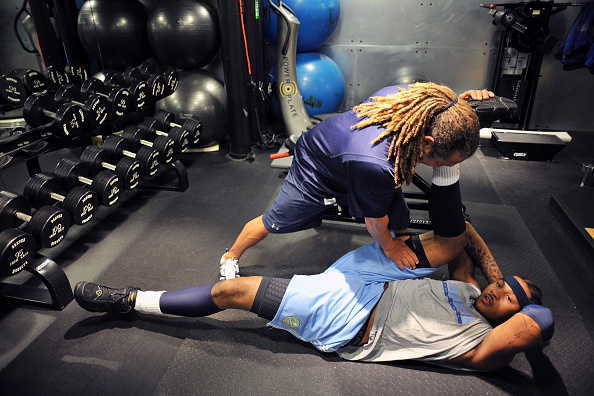
Hess puts NBA guard Austin Mills through an in-season game-day workout, the same assessment-first progression run with every athlete and executive on the MATrX system.

The Compensation Loop
Every joint in the body is controlled by opposing muscle groups. When one side of that pair weakens or goes neurologically quiet, the nervous system does not stop the movement, it reroutes the load to a neighboring muscle group instead. The pattern still looks normal from the outside. What changes is which tissue is absorbing the work, and that tissue was never built to carry it alone.
Generic strength programming has no mechanism to catch this. A template built around exercise selection, sets, and progressive overload assumes every muscle in the chain is already firing at full capacity, then adds load on top of that assumption. If the assumption is wrong, more volume does not correct the underlying weakness, it drives the compensating muscle group harder and accelerates the exact pattern causing the problem. This is why someone can train consistently for years and still develop the same shoulder, hip, or low-back issue: the program was strengthening the compensation, not the deficit that caused it.
Neuromuscular Reset
A MATrX session does not open with a workout. It opens with a series of manual muscle tests, checking each muscle's ability to hold a contraction through a specific joint angle. Comparing side to side and range to range identifies exactly which muscle the nervous system has turned down, rather than guessing from where the pain or tightness happens to show up.
The correction that follows is not stretching and not strength training. It is a short series of low-load isometric contractions applied at the precise angle where a muscle tested weak, intended to re-establish the signal between brain and muscle rather than to fatigue or lengthen the tissue. Muscles that tested inhibited at the start of a session typically retest stronger by the end of it, and the muscle groups that had been compensating are asked to do less work for the same movement. For an executive client, the relevant result is not a stretch that wears off by the next morning, it is a nervous system relearning how to recruit the muscle it had quietly stopped using.
Hess applies the same testing-and-correction system to Colorado Rapids goalkeeper William Yarbrough, evidence the method holds across sports, not just the Nuggets roster he coached for 21 years.
Traditional Training vs. The Hess MATrX System
| Traditional Personal Training | Hess MATrX System | |
|---|---|---|
| Assessment Method | Program assembled from a standard template; strength and mobility are assumed, not tested. | Every major muscle group manually tested for firing capacity through its full range before a single exercise is assigned. |
| Practitioner Credentialing | Delivered by a general personal-training certification, typically earned in a weekend course. | Delivered by a credentialed Muscle Activation Techniques (MAT) practitioner with 21 years coaching NBA strength and conditioning. |
| Session Focus | Volume and fatigue: more sets, more weight, more time under tension. | Firing capacity: isolating and correcting the specific muscle the nervous system has stopped recruiting. |
| Medical Integration | None. Clinical concerns are referred out with no coordination between trainer and outside provider. | Routed through a separate, affiliated medical practice for labs, HRT, and peptide protocols, coordinated with training and never prescribed by the training staff. |
| Longevity Outcomes | Optimized for short-term performance; compensation patterns and joint wear often resurface once the program ends. | Optimized for durability: correcting the compensation pattern at its source reduces the load driving long-term joint breakdown. |
Assessment Method
Traditional Personal Training
Program assembled from a standard template; strength and mobility are assumed, not tested.
Hess MATrX System
Every major muscle group manually tested for firing capacity through its full range before a single exercise is assigned.
Practitioner Credentialing
Traditional Personal Training
Delivered by a general personal-training certification, typically earned in a weekend course.
Hess MATrX System
Delivered by a credentialed Muscle Activation Techniques (MAT) practitioner with 21 years coaching NBA strength and conditioning.
Session Focus
Traditional Personal Training
Volume and fatigue: more sets, more weight, more time under tension.
Hess MATrX System
Firing capacity: isolating and correcting the specific muscle the nervous system has stopped recruiting.
Medical Integration
Traditional Personal Training
None. Clinical concerns are referred out with no coordination between trainer and outside provider.
Hess MATrX System
Routed through a separate, affiliated medical practice for labs, HRT, and peptide protocols, coordinated with training and never prescribed by the training staff.
Longevity Outcomes
Traditional Personal Training
Optimized for short-term performance; compensation patterns and joint wear often resurface once the program ends.
Hess MATrX System
Optimized for durability: correcting the compensation pattern at its source reduces the load driving long-term joint breakdown.